
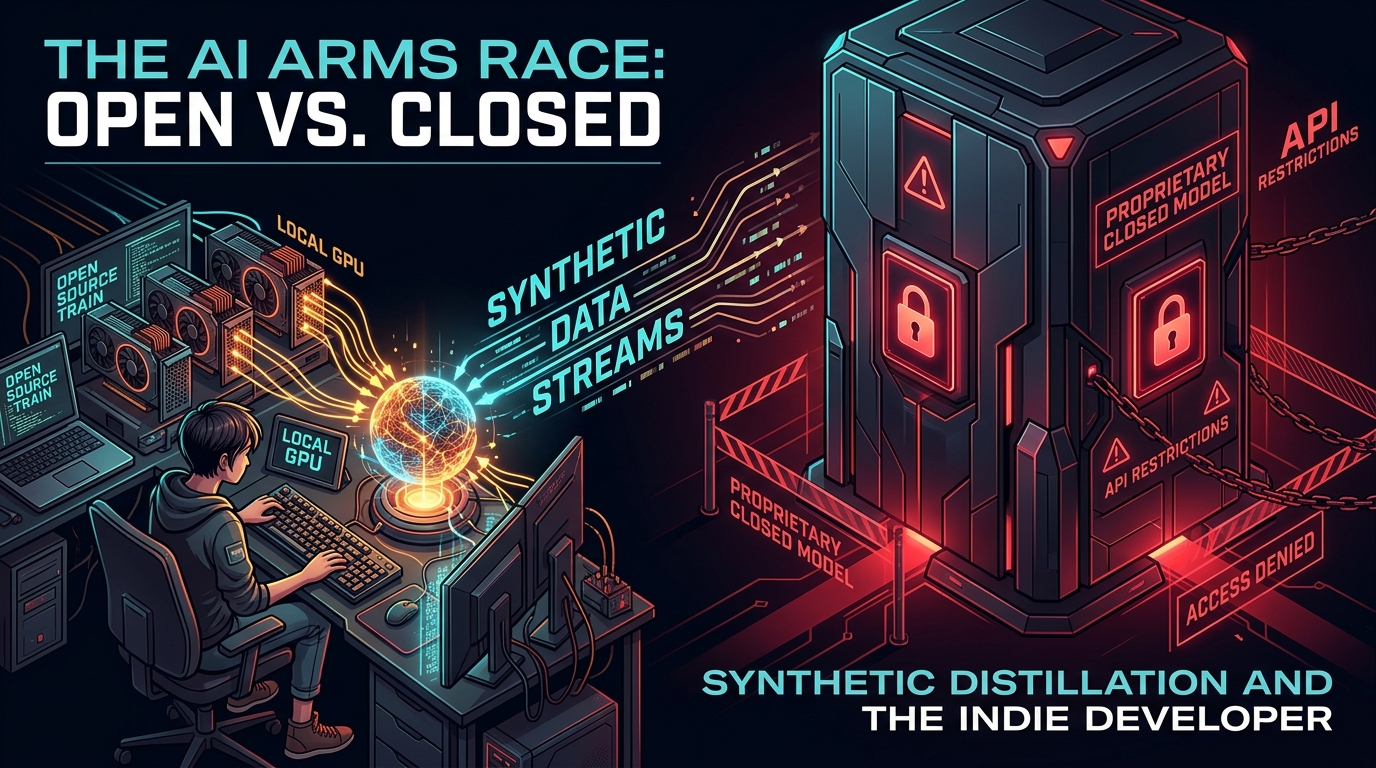
When Felix Kjellberg (known globally as PewDiePie) set out to build and train his own local artificial intelligence model on private hardware, he encountered an insurmountable barrier that every independent AI engineer recognizes: OpenAI banned his account twice.
His technical approach was straightforward and standard practice across contemporary machine learning research: he utilized OpenAI's frontier API to generate synthetic datasets, reasoning prompts, and structured answer pairs to fine-tune a smaller, sovereign model running locally on consumer GPU hardware. However, this workflow collided directly with Section 2(c) of OpenAI's Terms of Use:
"You may not... (iii) use output from the Services to develop models that compete with OpenAI."
— OpenAI Terms of Service, Restrictions on Service UsageThe Core Irony: "Same Idea, Opposite Consequences"
The incident quickly captured the attention of the engineering community because it crystallizes the single greatest paradox of the generative AI era. As I synthesized on X (formerly Twitter):
• PewDiePie trying to distill GPT into a local model
• OpenAI ban his account
• OpenAI trained on the open web.
• PewDiePie tried to train from the model’s answers.
• Same idea, opposite consequences.
• PewDiePie says OpenAI banned him twice while he was building a local model.
What is Model Distillation and Why Does It Matter?
In modern deep learning, knowledge distillation (introduced conceptually by Geoffrey Hinton et al.) is a technique whereby a compact "student" model is trained to emulate the outputs, reasoning chains, or latent representations of a massive "teacher" model.
Training a frontier model from scratch costs tens of millions of dollars in compute (clusters of tens of thousands of H100 GPUs) and consumes gigawatt-hours of electricity. Individual creators and open-source researchers cannot afford this. What they can afford is:
- Prompting a frontier model (like GPT-4o) with complex reasoning questions across diverse domains.
- Collecting thousands of high-quality, synthetic question-answer pairs (instruction tuning).
- Fine-tuning an open-weights small language model (like Llama 3, Mistral, or Gemma) on that synthetic dataset using quantized Low-Rank Adaptation (QLoRA) on a consumer RTX 4090 or Apple Silicon Mac.
This is precisely what PewDiePie attempted. And it is precisely what frontier labs are systematically using API filters and account termination mechanisms to prevent.
The Asymmetry: Scraping the Commons vs. Enclosing the Output
The philosophical and legal crux of this dispute lies in the profound double standard governing AI training data:
Phase 1: The Frontier Harvest
Frontier labs crawled trillions of words from Wikipedia, Reddit, personal blogs, open-source repositories, and YouTube transcripts without requesting individual permission, claiming broad protection under fair use doctrine.
Phase 2: The Output Enclosure
Once those models were trained on humanity's collective commons, the labs enclosed the resulting synthesis. Using contractual terms of service, they forbid any developer from learning from or fine-tuning on those outputs.
When frontier labs scrape the web, it is framed as innovation and progress. When an individual creator trains on model answers, it is labeled a terms-of-service violation and punished with instant banishment. Same idea, opposite consequences.
The Rise of Sovereign Local AI and Developer Autonomy
Despite API crackdowns, the momentum behind local AI is unstoppable. Developers, creators, and privacy-conscious users increasingly reject cloud-tethered subscription dependencies where:
- Your access can be revoked arbitrarily at any time.
- Your prompts and sensitive data are transmitted to corporate data centers.
- Model guardrails and behavioral alignments shift without notice.
PewDiePie's public struggle demonstrates why the open-weights ecosystem—supported by projects like Ollama, llama.cpp, and vLLM—is the ultimate safeguard for digital autonomy. Even if corporate APIs block synthetic distillation, open-source communities are collaborating on permissively licensed synthetic datasets (such as Cosmopedia, OpenHermes, and UltraChat) that no single corporate entity can turn off.
Verified X Discussion & Primary References
Explore the ongoing discussion and source documentation regarding model distillation, terms of service enforcement, and local AI sovereignty: